

Kitchen and Eating Aids for Parkinson's
Mealtime is the most commonly cited daily living challenge in Parkinson's Disease. The right kitchen adaptive aids — matched to the specific symptom affecting each task — restore independence at the table and reduce caregiver burden without requiring major home modifications or clinical intervention.

Writing and Fine Motor Aids for Parkinson's
Handwriting is one of the earliest fine motor skills affected by Parkinson's Disease. Tremor, reduced grip strength, and slowness of movement each disrupt writing differently, which means the most effective writing aids depend on identifying which symptom is driving the difficulty before selecting a tool.
Utensils and Cutlery
Action tremor, which activates during intentional movement, is most disruptive during eating because it peaks precisely when a person reaches for food or brings a utensil to their mouth. Weighted utensils work by adding mass to the handle, partially dampening that oscillatory movement and giving the user more control through the meal.
Most weighted utensils are available in spoon, fork, and knife configurations, with handle weights ranging from 100 to 300 grams. Ergonomic curves and built-in grip padding reduce the effort required to hold, which is important for Parkinson's patients who may experience both tremor and reduced hand strength simultaneously. Spoon-fork combination utensils support one-handed eating when bilateral coordination is reduced.
One important caveat: weighted utensils are most effective for mild-to-moderate action tremor. As tremor severity increases, the added weight can become fatiguing over a full meal. At that stage, a wearable tremor stabilizing device used during mealtimes addresses the tremor itself rather than compensating for it.
Plates, Bowls, and Drinkware
Plate guards attach to the rim of a standard dinner plate, creating a raised edge that prevents food from being pushed off while scooping. Scoop dishes achieve the same goal with a curved interior that naturally guides food toward the utensil. Both are low-cost, dishwasher-safe, and among the most widely recommended mealtime aids by occupational therapists working with Parkinson's patients.
Non-slip mats placed under plates and bowls keep them anchored to the table, eliminating the need to stabilize a dish with one hand while eating with the other. For drinking, two-handled mugs distribute grip effort across both hands and reduce the leverage demand on any single grip point. Weighted mugs add stability during lifting. Lidded travel cups with wide straws or sipper openings support independent hydration for patients with significant hand tremor or spillage concerns.
Kitchen Preparation Aids
Meal preparation involves a range of high-demand tasks requiring grip strength and coordination that can become unsafe or exhausting as Parkinson's progresses. Rocker knives eliminate the need for a downward stabbing motion by using a curved blade that rocks through food with a single-handed rolling motion, significantly reducing the coordination demand of cutting. Non-slip cutting boards with corner guards keep food secure during preparation without requiring the patient to manually stabilize the board.
Electric jar openers and battery-operated can openers remove entirely the need for the tight rotational grip that standard jars and cans require. Lever-style faucet handles replace twist knobs with a single-finger or palm-operated tap that remains accessible even with significantly reduced hand function. Touch-activated taps eliminate the need for a grip altogether and are now widely available at standard home improvement retailers.
Pens, Pencils, and Writing Instruments
Weighted pens and wide-barrel pens are the most commonly recommended writing aids for Parkinson's patients with action tremor. The added weight provides resistance against tremor oscillation during the writing stroke. Wide-barrel designs reduce the precision grip required, making sustained writing less fatiguing for patients with reduced hand strength alongside tremor. Ergonomic pencil grips achieve a similar result on standard pens and pencils without requiring a specialized purchase.
For tablet and touchscreen use, large-tip styluses reduce the fine motor precision required to navigate a phone or e-reader accurately. These are widely available and low-cost, making them a practical first step for patients whose primary writing need has shifted to digital devices.
When a Pen Is Not Enough — Wearable Solutions
Weighted pens and grip aids address the tool, not the tremor. They make writing more manageable but do not reduce the underlying hand movement. For patients whose tremor has progressed beyond what grip-based aids can compensate for, a wearable tremor stabilizing device is the logical next step.
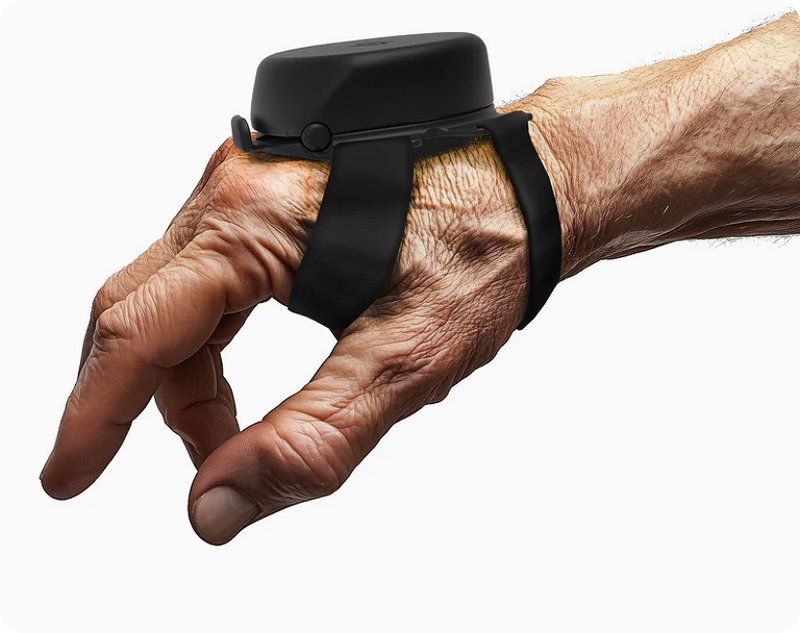
The Steadi-3 Plus is a passive wearable glove that uses patented magnetic tuned mass damper technology to counteract hand tremor in real time. There are no batteries, no electronics, and no calibration required. The device responds to the user's own tremor motion, moving an internal stabilizer in the opposite direction to reduce oscillation. It weighs 290 grams and is worn during daily activities, including writing, signing documents, eating, and using a phone.
Clinical evidence from a placebo-controlled study shows 84% of participants demonstrated improved tremor control with the Steadi-3 Plus. It is FDA-registered, available without a prescription, and eligible for FSA and HSA reimbursement.
Voice-to-Text and Digital Writing Alternatives
When physical writing aids are no longer sufficient, voice-to-text software provides a complete functional substitute. Dragon NaturallySpeaking remains the most accurate dedicated dictation software for desktop use. iOS and Android both include built-in dictation accessible from any keyboard. Google Docs voice input supports long-form document creation entirely by voice. For patients who also experience hypophonia, pairing voice-to-text with a portable voice amplifier improves dictation accuracy and reduces speaking effort.
Wearable Devices for Parkinson's Tremor Control
Standard adaptive aids modify the task environment — they make activities easier to perform despite the tremor, but do not change the tremor itself. A wearable tremor device works differently. It acts directly on the hand, reducing oscillatory movement before it affects the task.
The Steadi-3 Plus is the leading passive wearable device for Parkinson's hand tremor. Its patented magnetic tuned mass damper technology requires no batteries, no charging, and no electronic components. It adapts automatically to each user's tremor frequency in real time and can be worn throughout the day across any hand-based activity — writing, dining, holding a cup or phone, morning grooming, and more.
Unlike electronic tremor-suppressing devices that require calibration and periodic charging, the Steadi-3 Plus is always ready. It is FDA-registered, supported by a placebo-controlled clinical study, and endorsed by occupational therapists and neurologists on Steadiwear's advisory board. Financing starts at $43 per month through Affirm, and FSA and HSA funds apply.
Mobility and Dressing Aids for Parkinson's
Mobility Aids — Canes, Walkers, and Beyond
Gait instability and freezing of gait are among the most disabling mid-to-late stage symptoms of Parkinson's disease. Standard quad canes provide lateral balance support for mild instability. Laser-cue canes project a visual line onto the floor, providing the brain's motor cortex with a stepping target that can interrupt a freezing episode and initiate forward movement.
Rollator walkers are generally preferred over standard walkers for Parkinson's patients because they allow a natural forward stride without the lift-and-place motion that can trigger freezing. The U-Step walker uses a spring-tension braking system that engages automatically when the grip is released, providing an additional layer of fall protection. At home, grab bars, bed rails, and threshold ramps address the specific transition points where falls most commonly occur. A physical therapist should be involved in device fitting and gait training.
Dressing Aids and Adaptive Clothing
Button hooks and zipper pulls reduce the precision of the grip required for fasteners to a single looping motion. Long-handled shoehorns allow shoes to be put on without bending. Sock aids hold a sock open at floor level, allowing it to be stepped into without requiring a forward bend or bilateral hand coordination. Elastic shoelaces and Velcro shoe closures eliminate the fine motor demand of tying entirely.
Adaptive clothing brands offer magnetic closures, side-opening designs, and wider necklines that simplify dressing without sacrificing appearance. Dressing sticks and reachers extend reach for patients whose bending or arm elevation is limited by rigidity or postural changes.
How Occupational Therapists Recommend Adaptive Equipment
An occupational therapist does not simply hand a patient a product list. In a formal evaluation, the OT observes the patient performing specific daily tasks, identifies where the functional breakdown occurs, and works backward to the most targeted solution for that specific deficit. For Parkinson's, this means distinguishing between tremor, rigidity, and bradykinesia as the primary driver of each ADL difficulty — since the right equipment differs significantly by symptom type.
OTs organize recommendations into three tiers: safety-first items for fall prevention, independence-support tools for ADL function, and quality-of-life tools for leisure and communication. For patients whose primary limitation is hand tremor, OTs most commonly recommend weighted utensils as a first step, ergonomic grip aids as a complement, and wearable stabilization devices, such as the Steadi-3 Plus, for those who need more than passive compensation.
To access an OT evaluation, ask your neurologist for a referral at your next appointment. Veterans can request an evaluation through their VA medical center. Whether you are starting with a single kitchen tool or building a complete adaptive setup, the Steadi-3 Plus is a natural first step for anyone whose primary challenge is hand tremor.
Choosing Adaptive Equipment by Tremor Type
Parkinson's disease involves more than one type of tremor, and selecting the wrong tool for the wrong tremor type produces poor results. Resting tremor occurs when the hand is at rest and typically reduces once intentional movement begins — making adaptive utensils and weighted pens less relevant for this type specifically. Action tremor occurs during intentional movement and is most disruptive during writing and eating. Weighted utensils, plate guards, and ergonomic writing aids are most effective here. Postural tremor occurs when holding a sustained position, such as a cup at arm's length, and responds best to devices that provide continuous stabilization throughout the hold.
The Steadi-3 Plus is effective across all three tremor types because its passive magnetic stabilization responds to whatever tremor motion is present — at rest, during movement, or while holding a position. For patients whose tremor profile includes more than one type, this makes it the most versatile wearable option currently available.
A practical starting guide: if your tremor most affects mealtimes, begin with weighted utensils and plate guards. If it most affects writing, start with a weighted pen and consider the Steadi-3 Plus if the pen alone is insufficient. If tremor is present across multiple daily activities, an OT evaluation will produce the most accurate and cost-effective equipment plan.
Frequently Asked Questions