
Best Weighted Glove for Tremors: Weighted Gloves vs. Passive Magnetic Stabilization
Finding the best weighted glove for tremors means navigating a range that spans basic fitness accessories, purpose-built medical devices, and fundamentally different stabilization technologies. This page compares the major technology categories against consistent criteria so the reader can make a decision that matches their tremor profile, lifestyle, and budget. There is no single best device for every patient; the right choice depends on tremor type, severity, and daily use needs.

How weighted gloves reduce tremors and where they fall short
Weighted gloves reduce visible tremor amplitude by adding mass to the hand, increasing the resistance the tremor must overcome. The proprioceptive input from weight resting on the back of the hand can also provide sensory feedback that improves hand awareness during tasks. Practical limitations: added weight causes hand fatigue during extended use, particularly for older adults or those with reduced grip strength; dexterity for fine motor tasks can be reduced; the mechanism does not adapt to tremor frequency or pattern. Generic weighted fitness gloves are not clinically validated for tremor management.
The five purpose-built anti-tremor gloves: what they are and how they differ
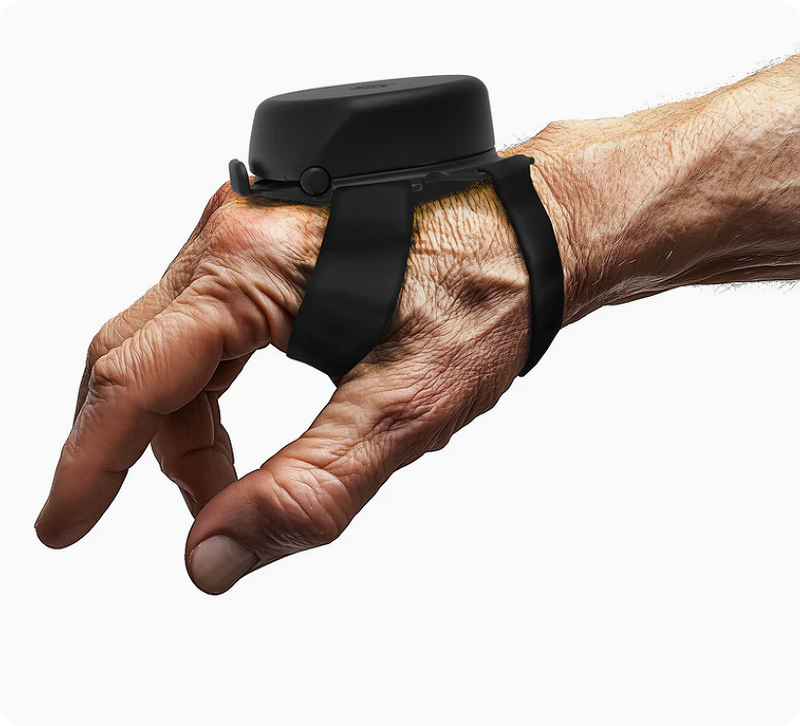
The five purpose-built device categories for hand tremor management are: magnetic tuned mass damper (Steadi-3), gyroscopic stabilization (GyroGlove), custom weighted orthotic (Readi-Steadi), spring-based tuned mass damper (Tremelo), and transcutaneous electrical nerve stimulation (Cala Trio). The Steadi-3 is an FDA-registered Class I medical device; in a placebo-controlled study, 84% of users showed improved tremor control. Cala Trio holds FDA De Novo clearance but requires a prescription and is cleared for Essential Tremor only. A healthcare provider can guide device selection.

Choosing a tremor glove by condition: Essential Tremor vs. Parkinson's Disease
Essential Tremor produces action tremor during voluntary movement such as writing, eating, and lifting; all five purpose-built device categories have applications for Essential Tremor. Parkinson's Disease involves both resting tremor and action tremor; purpose-built mechanical glove devices are most effective for the action component. Cala Trio is FDA-cleared for Essential Tremor only and does not carry a Parkinson's Disease indication. The Steadi-3 is used for both Essential Tremor and Parkinson's Disease action tremor. A neurologist should confirm tremor type before device selection.
How to compare tremor gloves: criteria that actually matter
Technology type determines how each device works and its implications for effectiveness and comfort. Power source matters: battery-free devices can be worn continuously; battery-dependent devices require charging management. Clinical evidence varies: distinguish manufacturer claims from placebo-controlled or blinded assessments where available. Regulatory status: FDA-registered (Steadi-3) and FDA De Novo cleared (Cala Trio) are different standards; not all devices carry either designation. Practical factors include prescription requirement, return policy, FSA/HSA eligibility, all-day wearability, and whether OT fitting is required.

Side-by-side comparison: the best anti-tremor glove options at a glance
Steadi-3: passive magnetic stabilization; battery-free; FDA-registered Class I; 84% of users showed improved control in a placebo-controlled study; FSA/HSA eligible; 30-day return; no prescription required; suitable for Essential Tremor and Parkinson's Disease action tremor. Cala Trio: nerve stimulation; session-based; FDA De Novo cleared for Essential Tremor only; prescription required. GyroGlove: gyroscopic; battery-powered; no independently published clinical study. Readi-Steadi: custom weighted orthotic; not FDA-registered; physician's order required. Generic weighted gloves: no clinical validation; appropriate for mild tremor experimentation only.
What clinical evidence and FDA status actually mean for tremor devices
"FDA approved" is used loosely across the tremor device market and refers to several distinct designations. FDA registration (Class I) means the manufacturer is registered with the FDA and meets Class I safety and labeling requirements; it does not require pre-market clinical evidence review. The Steadi-3 is an FDA-registered Class I medical device. FDA De Novo clearance requires clinical evidence submission and FDA review; Cala Trio holds this designation for Essential Tremor. In a placebo-controlled study, 84% of Steadi-3 users showed improved tremor control, with blinded neurologist assessment confirming 70% improvement over placebo.
Questions to ask your doctor before choosing a tremor glove
"Is my tremor primarily an action tremor, a resting tremor, or both?" is the most foundational question; the answer shapes which device categories apply. "Do I have any contraindications for electrical stimulation?" is important for patients with implanted devices such as pacemakers or cochlear implants. "Would I benefit from an OT evaluation?" helps narrow device fit, weight, and style to the individual. "Can I document medical necessity for FSA or HSA reimbursement?" applies to the Steadi-3 specifically; consult a benefits administrator for confirmation.
Frequently Asked Questions
What is the best tremor glove for Essential Tremor?
No single device is best for every Essential Tremor patient; the right choice depends on tremor severity, lifestyle, and tolerance for battery management, prescription requirements, and cost. For all-day battery-free wear with controlled clinical evidence, the Steadi-3 is an FDA-registered Class I medical device in which 84% of users showed improved tremor control in a placebo-controlled study. For the strongest independently published clinical evidence and FDA De Novo clearance for Essential Tremor, Cala Trio meets the highest regulatory standard, though it requires a prescription. Consult a neurologist or occupational therapist.
Do weighted gloves help with Parkinson's Disease tremors?
Purpose-built tremor gloves, including the Steadi-3, Readi-Steadi, and GyroGlove, have applications for Parkinson's Disease action tremor, the shaking that occurs during voluntary movement. Generic weighted fitness gloves may provide limited benefit for Parkinson's Disease action tremor but are not designed or validated for this purpose. Parkinson's Disease resting tremor, which occurs when the limb is at rest, responds less well to mechanical glove devices. Cala Trio is currently FDA-cleared for Essential Tremor only. A movement disorder neurologist is best positioned to recommend a device for each patient's specific Parkinson's tremor presentation.
Is the Steadi-3 FDA approved?
The Steadi-3 is an FDA-registered Class I medical device; FDA registration means the manufacturer is registered with the FDA and the device meets Class I safety and labeling requirements. FDA registration is not the same as FDA clearance or FDA De Novo clearance, which involve pre-market clinical evidence review; among the devices in this category, Cala Trio holds FDA De Novo clearance for Essential Tremor, the highest current regulatory standard. FDA registration still represents meaningful regulatory oversight and distinguishes the Steadi-3 from generic weighted fitness gloves, which carry no FDA designation.
Can I use FSA or HSA funds to pay for the Steadi-3?
Yes, the Steadi-3 is eligible for FSA and HSA reimbursement as an FDA-registered Class I medical device. Steadiwear provides a downloadable Letter of Medical Necessity template to support reimbursement claims through your benefits administrator. FSA/HSA eligibility does not mean automatic coverage; confirm with your plan administrator before purchase. Generic weighted fitness gloves may or may not qualify depending on the specific plan and whether a healthcare provider has prescribed them. The Steadi-3 does not currently have direct insurance coverage, but FSA and HSA reimbursement provides a meaningful cost-reduction pathway.
What is the difference between a weighted glove and passive magnetic stabilization?
A standard weighted glove reduces tremor amplitude by adding mass to the hand; the heavier the hand, the less it moves in response to tremor. Passive magnetic stabilization, as used in the Steadi-3, works through a tuned mass damper: a weighted disc moves in the opposite direction of the tremor, creating a counterforce through magnetic repulsion rather than simply making the hand heavier. The key practical difference is that passive magnetic stabilization generates a targeted counterforce that responds to the tremor motion itself, without requiring the hand to bear additional dead weight. Neither approach is a cure; both support daily independence and control.