
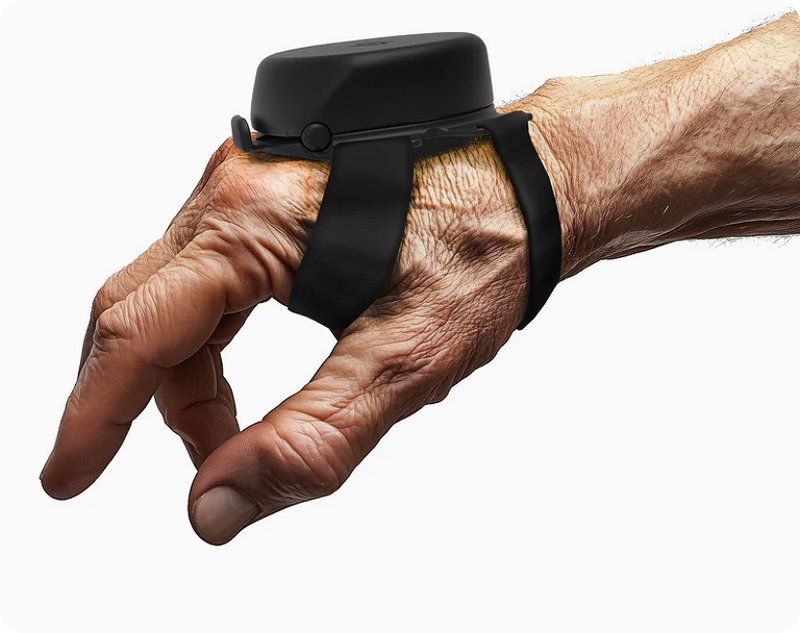

How to use this symptom comparison
Around 10 million Americans live with Essential Tremor, while roughly 1 million — according to the Parkinson's Foundation — have Parkinson's Disease. Both conditions cause shaking, yet their symptoms follow different rules. This page focuses only on the differences in symptoms so you can prepare for your next appointment with clarity and confidence. For a complete overview comparing Essential Tremor and Parkinson's as whole conditions, visit our Essential Tremor vs Parkinson's Disease guide.

Tremor type: action vs resting, the core difference
The most useful distinction between Essential Tremor and Parkinson's is the timing of tremor onset. Essential Tremor activates during movement: writing, eating, and holding a cup. Parkinson's tremor is present at rest, often with a characteristic pill-rolling motion between the thumb and forefinger. Essential Tremor tends toward higher frequency with smaller amplitude, while Parkinson's tremor is slower with wider movement. A re-emergent tremor, where shaking returns briefly after holding a posture, is a hallmark of Parkinson's.
Side-by-side symptom comparison at a glance
Below is a printable reference you can bring to your neurology appointment. It covers tremor type, typical onset age, affected body parts, associated symptoms, progression rate, alcohol response, and medication response for both conditions. We designed this in a shareable two-column format so you can instantly see the difference between Essential Tremor and Parkinson's. Save or print the image and review it with your doctor. This chart is a conversation starter, not a diagnosis.
Associated symptoms beyond tremor
Tremor alone cannot distinguish these two conditions. Parkinson's brings additional motor symptoms: bradykinesia (slowed movement), rigidity, and postural instability that increases fall risk. Micrographia, in which handwriting gradually shrinks, is a signature of Parkinson's. Essential Tremor handwriting grows larger and shakier instead. Voice involvement also diverges. Essential Tremor commonly produces a tremulous, wavering voice and a visible head tremor in a "yes yes" or "no no" pattern. Parkinson's rarely causes voice tremor, though it may soften speech.
Body parts affected and how symptoms progress
Parkinson's almost always starts on one side of the body, then spreads to the opposite side over months or years. Essential Tremor typically presents bilaterally from the start, though one side may shake more. Beyond the hands, Essential Tremor commonly involves the head and voice, while the legs are rarely affected. Parkinson's tremor often reaches the jaw, chin, and leg. Parkinson's progresses faster across more body systems. Essential Tremor worsens slowly, remaining limited to tremor.
When symptoms overlap, the gray zone
Not every case fits a textbook profile. Some patients have both conditions, especially older adults with long-standing Essential Tremor. Research suggests that up to 20 to 30 percent of people with advanced Essential Tremor develop a resting tremor component. Tremor-dominant Parkinson's can also resemble Essential Tremor early on. When examination alone cannot clarify, diagnostic imaging such as DaTscan and olfactory testing can help. A movement disorder specialist is often the right referral for ambiguous cases.
What to track before your neurologist appointment
Before your visit, start a symptom log. Record when tremor appears: during activity, at rest, or both. Note which side started first and whether shaking has spread. Track whether a small amount of alcohol temporarily reduces the tremor, which suggests Essential Tremor, or has no effect. Document family history and list current medications, since some drugs worsen shaking. Note changes in handwriting, voice, sense of smell, and sleep quality. Download our symptom tracker to organize everything.
Frequently Asked Questions