

Understanding Assistive Technology for Parkinson's
Assistive technology is any device that helps a person with a disability perform daily tasks more independently. For Parkinson's patients, this spans over-the-counter adaptive equipment, clinically validated wearables, and FDA-regulated medical devices. Occupational therapists are the primary resource for matching the right tools to a person's specific needs.

Adaptive Equipment vs. Medical Devices
Adaptive equipment like weighted utensils and grab bars requires no prescription. Medical devices such as deep brain stimulation systems are FDA-cleared and require clinical evaluation. The Steadi-3 Plus sits between these categories: FDA-registered, clinically validated, and available for direct purchase. FSA and HSA funds apply through the FSA/HSA eligibility page.

How to Choose the Right Parkinson’s Assistive Technology
The right assistive technology depends on your symptoms and how they affect daily tasks. Many patients start with simple adaptive tools and add more targeted solutions, such as wearable devices, as symptoms progress. An occupational therapist can help prioritize the most effective options for your current needs.
Types of Parkinson's Assistive Devices
Not all Parkinson's adaptive equipment addresses the same symptom. Tremor, gait instability, communication difficulties, and fine motor decline each require a different category of tool, making symptom-first selection far more useful than a generic product list.
Disease progression also shapes which tools matter most. Early-stage patients benefit primarily from fine-motor aids, while mid-stage patients need mobility aids. Late-stage patients and caregivers shift focus toward communication devices and home safety systems.
Mobility Aids and Fall Prevention
Falls are among the most serious complications of mid-to-late stage Parkinson's disease. Standard quad canes provide balance support for mild instability, while laser-cue canes help patients with freezing of gait by projecting a visual stepping line on the floor. Rollator walkers and U-Step walkers offer stability with built-in braking designed specifically for PD gait patterns. At home, grab bars near the toilet, shower, and bed significantly reduce the risk of falls. Non-slip footwear, bed rails, and a professional home safety assessment by an OT complete a practical fall prevention plan.
Writing and Fine Motor Aids
Tremor affecting hand function is one of the most disruptive early-stage symptoms and one of the least addressed by general AT guides. Weighted pens and pencil grips partially dampen resting or action tremor during handwriting. Large-grip styluses reduce the fine-motor demands of tablet use. Voice-to-text software on iOS and Android provides a reliable substitute when handwriting becomes inconsistent. For patients who want to address the tremor directly rather than work around it, a wearable tremor stabilizing glove such as the Steadi-3 Plus is the most targeted solution currently available.
Eating and Mealtime Adaptive Tools
Mealtime is often the first area where Parkinson's tremor visibly affects quality of life. Weighted utensils, plate guards, non-slip mats, and angled bowls each address a specific mealtime challenge. Electric jar openers and lever-style bottle openers remove the need for a tight twisting grip. Rocker knives allow one-handed cutting without requiring bilateral coordination. These tools are low-cost, widely available, and can be introduced gradually as symptoms progress.
Wearable and Technology-Driven Devices
Wearable technology for Parkinson's now includes cueing devices for freezing of gait, smartwatches with fall detection, medication reminder apps, and tremor-dampening gloves. The Steadi-3 Plus is the leading passive wearable for hand tremor, using patented magnetic technology and requiring no batteries. See the dedicated section below for full details.
Communication and Voice Aids
Portable voice amplifiers help patients with hypophonia project their voice in everyday settings. Speech-to-text apps serve both writing and communication functions. For advanced-stage patients whose speech is severely affected, AAC devices, ranging from letter boards to tablet-based synthesized-speech apps, provide a reliable means of communication. A speech-language pathologist can assess which option best fits a patient's current needs and cognitive profile.
Home Safety and Daily Living Technology
Voice-activated smart speakers allow lights, thermostats, and door locks to be controlled hands-free. Automated medication dispensers reduce the cognitive burden of complex dosing schedules. Personal emergency response systems and fall-detection wearables allow patients to summon help instantly or automatically trigger an alert. Layering several of these technologies creates a meaningful safety net for patients living independently.
The Steadi-3 Plus — A Wearable Assistive Glove for Parkinson's Tremors
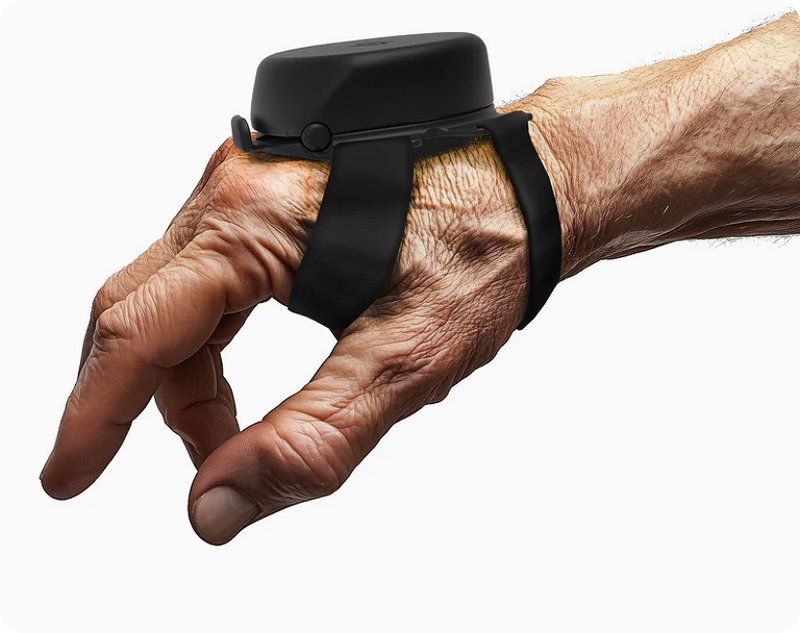
Most AT guides for Parkinson's leave the tremor category unaddressed. The Steadi-3 Plus was designed to fill that gap. It is a wearable glove that uses patented magnetic tuned mass damper technology to passively stabilize the hand against tremor, with no batteries, no charging, and no electronics. The device responds to the user's tremor motion in real time, counteracting the oscillation the same way the technology stabilizes high-rise buildings against seismic movement.
It is designed for Parkinson's patients with resting or action tremors affecting writing, eating, holding a cup, or using a phone. At 290 grams with adjustable straps, it can be worn throughout the day. Clinical evidence from a placebo-controlled study shows 84% of participants demonstrated improved tremor control. It is an FDA-registered Class I device available without a prescription.
Accessing Parkinson's Assistive Technology
OT Referral
Ask your neurologist for an occupational therapy referral at your next appointment. An OT evaluates your functional limitations, observes you as you perform daily tasks, and recommends a prioritized set of tools tailored to your home and routine. Most OT evaluation sessions are covered by insurance when ordered by a physician.
Insurance and Medicare Coverage
Durable Medical Equipment, including walkers, canes, and manual wheelchairs, is typically covered by Medicare and private insurance, provided there is a physician's prescription and documentation of medical necessity. Adaptive utensils, wearable tremor devices, and low-tech daily living aids are generally not covered. If a DME claim is denied, you have the right to appeal. A Letter of Medical Necessity from your neurologist or OT strengthens any appeal submission.
VA Benefits for Veterans
Veterans with Parkinson's disease linked to Agent Orange exposure qualify for presumptive service connection, giving them access to a wide range of VA healthcare and AT benefits. The VA Prosthetics and Sensory Aids Service covers mobility aids, communication devices, and home modification equipment. Initiate a request through your VA neurologist or OT. Additional guidance for veterans is available at the VA benefits page.
Free State and Nonprofit Resources
Every U.S. state operates an AT Act program with device lending libraries and demonstration centers. The Parkinson's Foundation HelpLine (1-800-4PD-INFO) connects patients with local OTs and community resources. The Davis Phinney Foundation and APDA offer grants that may offset device costs for patients with demonstrated financial need.
Assistive Technology by Disease Stage
Early-stage patients (Hoehn and Yahr 1 to 2) benefit most from fine-motor aids: writing tools, adaptive utensils, and wearable tremor devices such as the Steadi-3 Plus. Mid-stage patients (HY 3) increasingly need mobility aids, grab bars, and fall prevention technology. Late-stage patients (HY 4 to 5) and their caregivers shift focus to communication devices, wheelchair adaptations, and caregiver-assist tools. AT needs should be reassessed annually as symptoms evolve. An OT review each year ensures that the tools in use continue to align with the person's current functional profile.
Frequently Asked Questions