
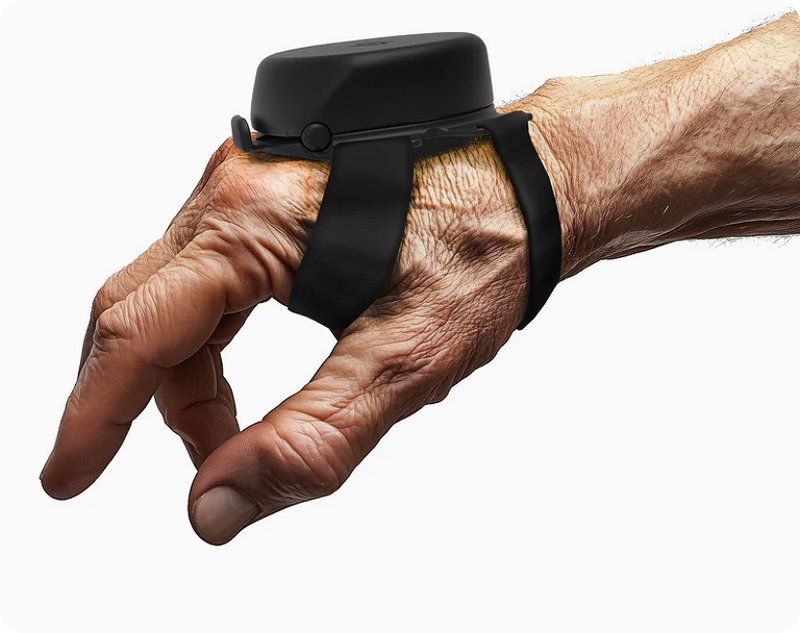

What Parkinson's Tremor Looks and Feels Like
Parkinson's Disease hand tremor is a resting tremor, meaning it occurs when the limb is relaxed. The classic presentation is a pill-rolling motion between the thumb and forefinger at a rhythmic 4–6 Hz frequency. It almost always starts on one side and stays noticeably asymmetric. According to the Parkinson's Foundation, roughly 70 to 80 percent of people with Parkinson's develop tremor, though approximately 20 percent never do. The shaking typically disappears briefly during deliberate movement and returns when the hand rests again.

Where Parkinson's Tremor Shows Up in the Body
Hands and fingers are the most common sites, producing the signature pill-rolling that many people associate with Parkinson's. Jaw and chin tremor can cause teeth to click and disrupt dentures, though it typically stops during chewing. Foot and leg tremor becomes visible when the limb is dangling but disappears when standing or walking. Lips and tongue may occasionally be affected. Some patients describe a Parkinson's intention tremor sensation, an internal shaking feeling that others cannot see but the patient strongly perceives as real.

Parkinson's Tremor vs Essential Tremor vs Other Shaking
The core distinction is timing. Parkinson's tremor appears at rest and fades with movement; Essential Tremor does the opposite, worsening during action like writing or holding a cup. Parkinson's tremor is asymmetric, while Essential Tremor typically affects both hands and commonly involves the head and voice. Essential Tremor is roughly eight times more common than Parkinson's, and some patients have both. Intention tremor that worsens near a target suggests cerebellar involvement.
Why Parkinson's Causes Tremor
Parkinson's tremor originates from the progressive loss of dopamine-producing neurons in the substantia nigra. As dopamine levels drop, abnormal oscillations develop in the basal ganglia and cerebello-thalamo-cortical circuits that regulate movement. An excess of acetylcholine relative to dopamine contributes to the rhythmic shaking. Tremor appears at rest because the brain's movement-signaling pathways misfire when the limb is not actively engaged. The asymmetry reflects the fact that neurodegeneration typically starts on one side of the brain before spreading, which is why tremor begins on one side.
Medical Treatments for Parkinson's Tremor
The treatment of tremor in Parkinson's Disease begins with medication. Levodopa and carbidopa are first-line, effective treatments for most patients, though the response to tremor varies. Dopamine agonists and anticholinergics help tremor-dominant cases, while amantadine and beta-blockers serve selected patients. Botulinum toxin targets localized, treatment-resistant tremor. When medication alone is insufficient, deep-brain stimulation offers a reversible, long-established surgical option. MR-guided focused ultrasound is a newer, incisionless alternative. Treatment is always individualized based on age, subtype, side effects, and functional goals.
Assistive Technology and Daily-Living Strategies
When medication and surgery are not enough on their own, assistive technology fills the gap. Stabilizing utensils help with eating. Weighted pens and non-slip mats support writing and kitchen tasks. The Steadi-3 is a battery-free, FDA-registered wearable glove that uses magnetic stabilization to reduce hand tremor during daily activities. It is clinically validated, lightweight, and FSA/HSA eligible. Voice-to-text software and dressing aids further preserve independence. What helps Parkinson's tremors most is combining medical treatment with practical assistive strategies.
Living and Moving Forward With Tremor
Exercise is as important as medication for Parkinson's management. Programs like Rock Steady Boxing and LSVT BIG are designed for Parkinson's patients and shown to slow functional decline. Stress and caffeine worsen tremor, while consistent sleep and hydration help. Socially, managing visible tremor in public takes practice and openness. Caregivers play a vital role by providing observation, emotional support, and assistance with daily tasks. Visit our caregiver support page for resources. Emerging research into new treatments for Parkinson's tremors, including closed-loop DBS, continues advancing.
Frequently Asked Questions
Progression is highly individual and variable across patients. Tremor usually remains on one side for years before spreading to the other side. In tremor-dominant Parkinson's, the tremor itself may worsen more slowly than other motor symptoms. Stress, fatigue, and medication timing can temporarily amplify shaking without representing true progression. Early, consistent treatment slows functional impact over time. Combining medication adherence, regular exercise, and assistive technology like the Steadi-3 helps preserve daily independence and quality of life as the condition evolves.