DBS vs focused ultrasound for essential tremor is a surgical decision facing patients whose tremor has not responded adequately to medication. Both procedures target the VIM nucleus of the thalamus, and both are reserved for medication-refractory Essential Tremor. They differ fundamentally in mechanism, reversibility, candidacy requirements, and recovery. This article walks through how the two procedures compare and what determines which option is appropriate for a given patient.
Two Surgical Paths for Medication-Refractory Essential Tremor
Both deep-brain stimulation and focused ultrasound thalamotomy are reserved for patients where propranolol, primidone, and second-line medications have failed to provide adequate tremor control. DBS received FDA approval for Essential Tremor in 1997; MRgFUS received FDA clearance in 2016. The structural difference between them is fundamental: DBS modulates tremor signals through an implanted electrode without destroying tissue, while focused ultrasound creates a permanent thermal lesion in the VIM nucleus without any incision. Decades of outcome data exist for DBS; robust five-year data are now established for focused ultrasound.
How Deep Brain Stimulation Works for Essential Tremor

Deep brain stimulation involves implanting a thin electrode into the VIM nucleus of the thalamus, connected to a neurostimulator placed near the collarbone. Electrical current modulates the abnormal neural signals that drive tremor. The procedure has been performed in over 80,000 patients globally, with clinical studies reporting up to 90% improvement in hand tremor. The key clinical advantage is adjustability: device settings can be changed after implantation as the disease progresses. Bilateral treatment is possible. Multiple programming sessions follow surgery before optimal tremor control is achieved.
How Focused Ultrasound Thalamotomy Works for Essential Tremor
Focused ultrasound thalamotomy uses converging ultrasound waves guided by real-time MRI to heat and permanently destroy targeted tissue in the VIM nucleus. No incision and no implants are involved. The patient is awake throughout, providing real-time feedback that guides targeting accuracy. It is performed as an outpatient procedure with same-day discharge. Published clinical data report 50-75% improvement in tremor for Essential Tremor. The critical distinction from DBS is permanence: the lesion cannot be adjusted, reversed, or re-treated at the same location.
DBS vs Focused Ultrasound for Essential Tremor: Key Differences
Six dimensions determine which procedure is most suitable for a given patient. Reversibility: DBS is adjustable and can be turned off; FUS creates a permanent lesion. Bilateral treatment: DBS addresses both sides; staged bilateral FUS requires a nine-month minimum wait. Recovery: DBS requires hospitalization and a weeks-long programming phase; FUS is same-day outpatient. Hardware: DBS carries risks of infection and battery replacement; FUS involves no implants. Skull density: FUS requires a ratio of at least 0.45. Long-term adaptability: DBS settings are updated as the disease progresses; FUS remains fixed.
The Skull Density Problem: Why Some Patients Cannot Have Focused Ultrasound
Approximately 15 to 20% of patients screened for focused ultrasound Essential Tremor treatment are excluded due to inadequate skull density ratio. FUS requires ultrasound waves to pass through the skull uniformly to reach the VIM nucleus with precision. High bone porosity scatters the waves, reducing targeting accuracy and increasing the risk of heating non-targeted tissue. An SDR of at least 0.45 is required and assessed via CT scan during pre-surgical screening. DBS has no equivalent anatomical barrier and is unaffected by skull density.
Who Is a Better Candidate for DBS?
DBS is the more appropriate surgical path for patients with bilateral hand tremor affecting both sides meaningfully. Younger patients for whom long-term treatment flexibility matters are strong candidates, as settings can be adjusted as Essential Tremor progresses. Patients excluded from focused ultrasound due to skull anatomy, those with Parkinson's Disease needing broader motor symptom control, and patients prepared for device maintenance over many years are also well-suited. DBS requires a willingness to undergo general anesthesia, accept implanted hardware, and commit to ongoing programming follow-up.
Who Is a Better Candidate for Focused Ultrasound Thalamotomy?
Focused ultrasound is better suited for patients with predominantly unilateral tremor affecting the dominant hand, older patients who prefer to avoid implant surgery, and those with comorbidities that increase surgical risk under general anesthesia. Adequate skull density ratio of at least 0.45 is a prerequisite. Anticoagulated patients face elevated DBS surgical risk and may be better served by FUS. Johns Hopkins data support over 80% improvement rates in appropriately selected patients. Patients must understand and accept that the thermal lesion is permanent and non-adjustable.
Long-Term Outcomes: What the Research Shows
Long-term outcome data now exist for both procedures. DBS efficacy data spans over 20 years and confirms sustained benefit with ongoing programming. A 2026 meta-analysis by Sabet et al. found bilateral DBS statistically superior to unilateral MRgFUS in total Clinical Rating Scale for Tremor scores. Focused ultrasound data show 73% tremor improvement sustained at five-year follow-up. However, a subset of FUS patients experience tremor recurrence as the lesion evolves. Unlike DBS, the FUS lesion cannot be adjusted when tremor returns, which carries the most clinical weight for younger patients.
Risks and Side Effects to Discuss with Your Neurosurgeon
Both procedures carry documented adverse event profiles. DBS hardware risks include infection in approximately 1 to 3% of cases, lead displacement, intracranial hemorrhage, and battery replacement surgery every three to five years. Programming-related side effects include changes in speech and balance. For focused ultrasound, adverse events are primarily transient paresthesia and gait imbalance, most resolving within months. A systematic review by Giordano et al. found persistent complications to be more common with MRgFUS than with DBS. A small risk of permanent neurological effects from the thermal lesion exists. Neither procedure guarantees complete tremor elimination.
Questions to Ask Your Neurosurgeon Before Choosing
Before any procedure, patients should ask: Am I a candidate for both DBS and focused ultrasound, or does my anatomy restrict me to one? What is my skull density ratio? Do I have bilateral tremor requiring treatment on both sides? How will either procedure accommodate tremor progression over time? What is the long-term follow-up and device maintenance plan for DBS? What are the institutional outcome rates at this surgical center? Is this procedure covered by my insurance or Medicare plan? Consulting a movement-disorder neurologist, rather than performing the surgery, is advisable.
When Surgery Is Not the Right Fit: Daily Tremor Management with the Steadi-3

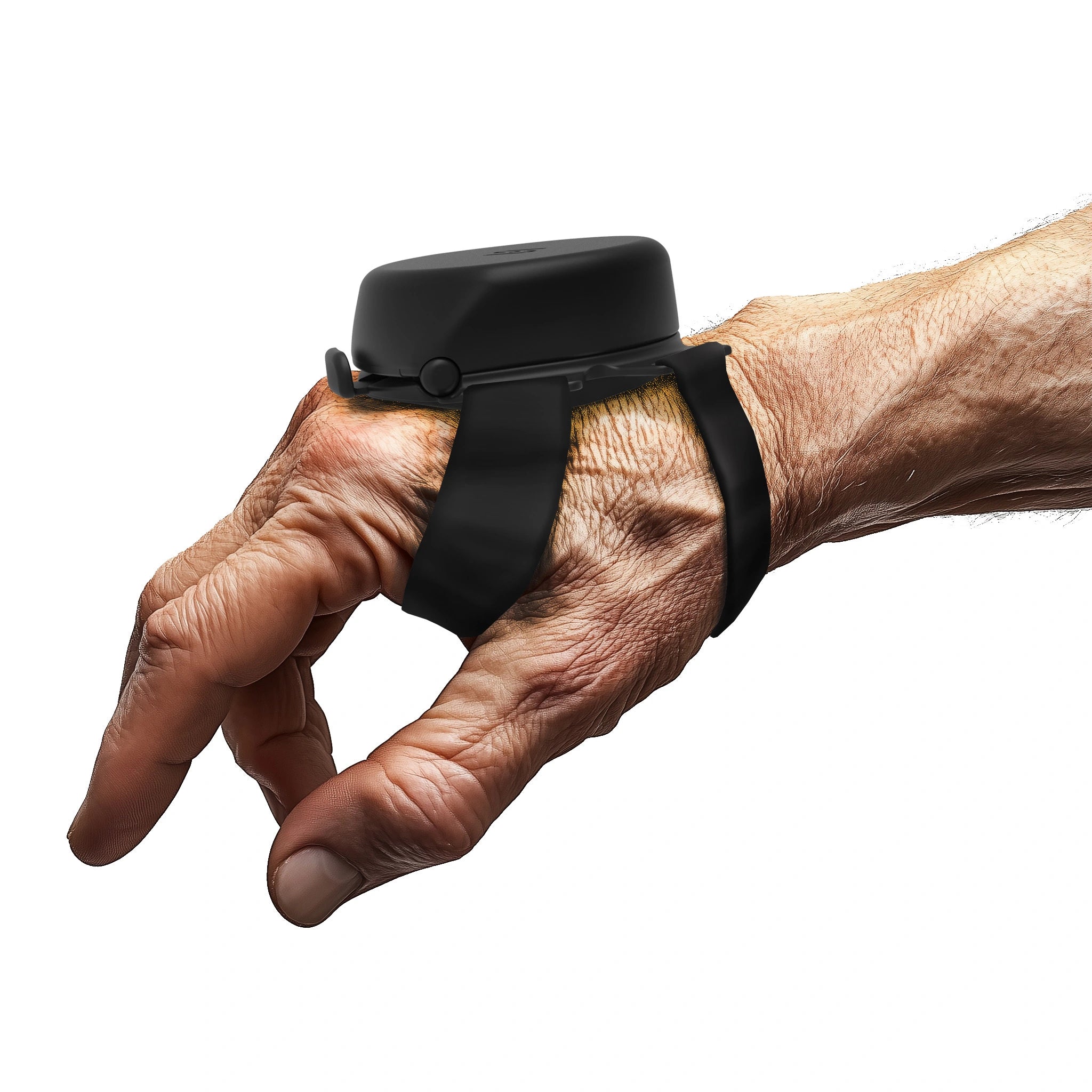
Many Essential Tremor patients are not surgical candidates. Some have tremors not severe enough to meet surgical thresholds. Others have skull anatomy excluding focused ultrasound or comorbidities, making DBS inadvisable. For this population, non-surgical daily tremor management is a clinically meaningful option. The Steadi-3 is a battery-free, FDA-registered Class I medical device using patented passive magnetic stabilization to reduce hand tremor during eating, writing, and daily tasks. No electrical components, no prescription, and no surgical risk are involved. Clinical validation showed that 84% of users reported a significant reduction in tremor.
Conclusion:
Both deep brain stimulation and focused ultrasound are clinically validated for medication-refractory Essential Tremor, with decades of evidence supporting DBS and robust five-year data now available for MRgFUS. The choice depends on whether bilateral treatment is needed, whether skull anatomy allows focused ultrasound, and how important long-term adjustability is, given the disease trajectory. DBS is suitable for patients needing bilateral control and future flexibility. FUS is suitable for patients with unilateral tremor, adequate skull density, and a preference for no implanted hardware. Both decisions require evaluation by a qualified neurosurgeon and movement disorder neurologist.